
CETIF 2026: 330 in the room, 100 online, twenty sessions in one day
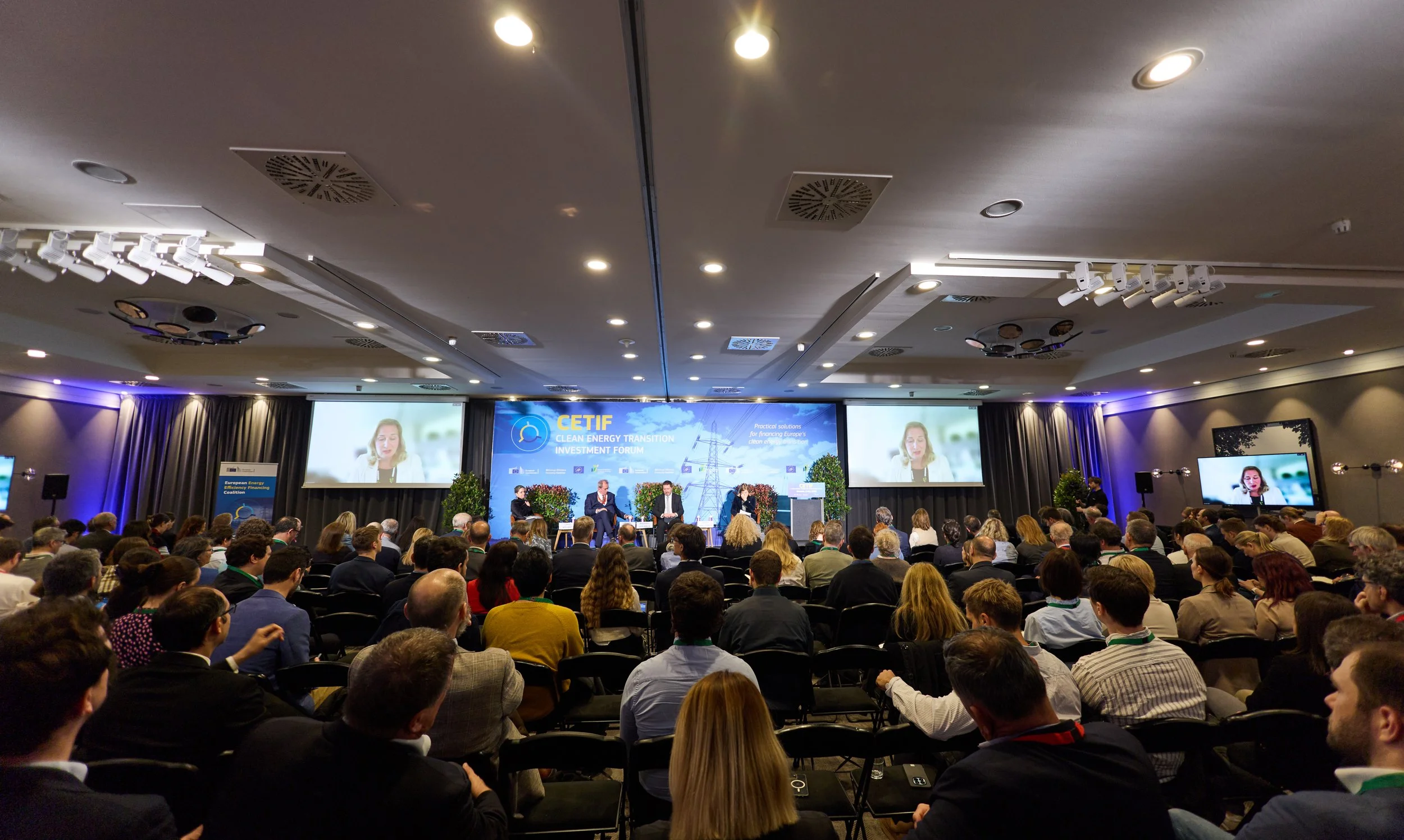
PRACSIS handled the practical and logistical organisation of the Clean Energy Transition Investment Forum (CETIF), held in Brussels on 6 May 2026, and built the event website. The forum is run by the European Commission's DG Energy and CINEA, under the European Energy Efficiency Financing Coalition.
The day brought together 330 participants in Brussels, with a further 100 following the live stream. It opened and closed with plenaries, and the main programme ran as twenty sessions in five successive rounds of parallel sessions across four rooms, with more than 40 speakers. Every session was livestreamed through the site.
The sessions dealt with practical ways to finance the clean energy transition: renovating housing and public buildings, building local investment pipelines, energy service companies, heating and cooling, and citizen-led projects. Projects from across Europe presented what they had actually financed and what had got in the way.
Four rooms running in parallel, all of them livestreamed, put most of the weight on the website and the AV setup. We built the site to handle registration, let participants choose their sessions in advance, and carry all four streams on the day, so anyone could follow the room they weren't sitting in.
CETIF 2026 was the event we chose this year for a full carbon footprint calculation. Measured with Trace, it came to 98.5 tonnes of CO2e, around 229 kg per attendee. To put that in context, that is roughly the equivalent of 49 cars driven for a year, or the amount of carbon that 492 tree seedlings would take ten years to absorb. Travel made up 92% of the total. That is the pattern we see at every international event we measure, and it is the part that is hardest to change without changing the event itself.
Also, CETIF was scheduled alongside several other meetings of the Commission, with many of the same people attending. That was done for practical reasons, but because travel dominates the footprint of an international event, bringing people to Brussels once instead of three or four times does a lot to reduce emissions.
How we calculated it
To arrive at the estimates above, we built a travel calculator into the registration form, which asked participants where they were travelling from and by what means, and gave them back their own figure along with the emissions factors we used. That data fed the assessment afterwards. Separately, we asked registrants to confirm a few days before the event, early enough to revise the catering order against real numbers rather than the registration list. The order matched what was needed, and little was thrown away. At the Radisson Collection Grand Place, what food waste there was went for biogas conversion and not to landfill.
